Monday, October 18, 2010

Garden Update October 2010


I started out writing a 2010 gardening update…

2010 will go down as the year that didn’t for my gardening efforts. Of the hundreds of Zinnia seeds I sowed in the spring in Toluca Lake, two plants finally emerged. In April I planted amazing tomato varietals seedlings in Carmel Valley. Deer that passed through the garden, also freely munching on roses and rhubarb, ravaged the adolescent plants. The highlights of the 2010 efforts were amazing roses and one very prolific heirloom pineapple tomato plant in Toluca Lake, and a lovely basket of delicate Meyer lemons from Carmel Valley. Not even the great botanist Hans Sloane got every seed to grow and the deer, well its their land really so who is the invader? I am at peace in the garden and pleased to be here.

Then I thought I’d review my 2010 gardening pictures to find a good one to illustrate the doom and gloom. I had forgotten about the volunteer Morning Glory in Toluca Lake, The amazing wildflowers in both Carmel Valley and the San Fernando Valley. The delicious miners lettuce that was the subject of my March posting and the amazing 12 foot tall thistle that took over a hillside of the Carmel property.

I am still at peace in the garden and happy to be here, and with this exercise, satisfied.

Thursday, March 25, 2010

Sutter's Mill Salad

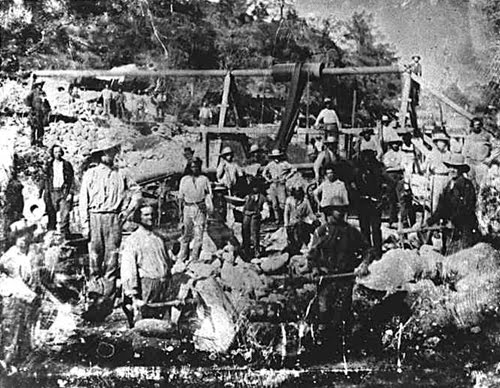
At the end of 1848, 20 thousand miners had migrated to the western gold fields surrounding Sutter’s Mill. Not to be left out, New York native, Michael Shea had several options to get his piece of the action. After rejecting the 2,000 mile overland trip that risked disease and Indian attacks, and the 16,000 mile trip around Cape Horn to San Francisco he opted to take the 6,063 mile route to Panama across the Isthmus connecting to a steamer from Panama City to San Francisco. After weeks in a 4x6 foot “cabin”, weeks being transferred up the Chagris River by natives and a very long wait in Panama City for the next steamer he finally arrived in San Francisco and made his way to the action. When Shea arrived at the end of 1849, 100,000 men were in the gold fields and by 1852 that number had more than doubled. The overwhelming population in that relatively small area made healthy nutrition hard to come by. The most debilitating result of this problem was the outbreaks of scurvy. When spots on the skin, spongy gums, and bleeding from the mucous membranes started, not all the gold in California could help. Shea and his newfound friends found the solution to this plague from the local Indians; claytonia perfoliata.

This plant that became known as “miners lettuce” is indigenous to the cooler climates of Northern California’s central coast region. You can imagine my surprise (and embarrassment) when I realized that the pesky, white flowered plant that withers and dies when the spring sun gets strong and that I had been randomly removing from our property in the Carmel Valley has been the delicious, nutritious, Miner’s Lettuce.

Nutritious? How did it save Shea and his fellow miners? Why some 160 years later do the foragers search it out? Vitamin C! We take the supplements, we drink the juice, but few of us know that this wild grower is loaded with Vitamin C. Three ounces (and by the way 3 ounces is a lot of lettuce) had more, much more vitamin C than most fruits and vegetables.

Look at this table:

Good Sources of Vitamin C per 100 g

Red Pepper (raw) 190

Guava 100

Miner’s Lettuce 120

Kiwi 90

Broccoli (raw) 89

Brussell Sprouts (raw) 85

Papaya 60

Strawberry 60

Orange 50

Lemon 40

Cantaloupe 40

Cauliflower 40

Grapefruit 30

Spinach 30

Cabbage 30

By the looks of this chart my Miner’s Lettuce salad has more vitamin c than a fresh fruit salad. With large fleshy leaves, miner's lettuce is a small succulent annual plant. It’s hard to make a mistake in the garden when looking for it. At the top of its slender stalks are saucer-shaped leaves that completely encircle the stems, appearing to be one circular leaf. Small white to pinkish flower clusters appear slightly above the unique leaves. Oblong-shaped leaves grow near the base of the plant. It’s all edible! I pinch it off from the bottom and it has the feel of spinach. Lately I have been using it like any kind of lettuce, spinach, or arugala. The real foragers tell me that if the miner’s lettuce isn’t too close to automobile traffic it shouldn’t be washed at all. I’m not buying into that! I wash it and give it a ride in the salad spinner. I haven’t steamed it yet but I will soon. I am heading back to the valley this week to pick another large bunch. Now that the temperatures are rising, Miner’s Lettuce is getting ready to shrivel up until next year.


What else am I getting rid of in the garden that I could be eating?

Monday, February 22, 2010

Don't Miss Tomatomania


This is the place to buy your seedlings. And look East coast followers...now in Connecticut!

Tuesday, February 16, 2010

Simon's Seeds


Its no secret that seeds are propagated in many instances by animals. Seeds that have a sticky exterior (burrs) hitch hike on an animal’s fur and fall off later . This, by the way proved to be the inspiration for the invention of Velcro. Other animals who hunt and hide seeds as a food source sometimes forget their stores and germination takes place. And of course there are the seeds that are eaten and sown around in the animal’s droppings, known by the experts as endozoochory, If you have ever been in the way of a falling bird dropping, you may have discovered as you cleaned the mess from your hair the presence of seeds.

All this leads to the events on a Friday afternoon that have resulted in what appears to be somewhat of a mitzvah. Meet Simon. Simon is an eight-year-old Beagle that my daughters purchased as a puppy and as he reached adult hood they promptly move to the opposite coast. No matter. Simon’s list of annoying “dog things”, that include the usual howling, wanting to walk when it’s cold, raining, or the middle of the night , is topped by Simon’s voracious appetite. I don’t really think he’s hungry, I think he has an obsession for ingesting things. Thankfully food tops the list. A pumpkin pie, a sack of flour, countless loaves of bread that were left just a inch too close to the edge of the kitchen counter, and once easily his own weight in an organic bread dough that was attempting to rise. Disgustingly he has the occasional bout of coprophagia and once he ingested (and eliminated, in perfect condition) a ladies thong underwear. So it was no surprise to me when I discovered that Simon had eaten a pound of wildflower seeds. Because it matters for my story it broke down to eight ounces of California Poppy (Eschscholzia californica), four ounces of Mountain Garland (Clarkia unguiculata), and four ounces of the delicious Farewell to Spring (Clarkia amoena.) As these were special ordered and cost $56.00 Simon was banished to the great outdoors of the garden in Toluca Lake. Bad dog! Later that afternoon, all was forgiven and Simon was allowed back in the house, after several hours of banishment and drinking an inordinate amount of water. As I settled in to attack past issues of The New Yorker, Simon promptly entered the den, stopped, looked at me with his soulful eyes and vomited up a neat pile of the wildflower mix. Bad Dog! Back to the garden.

Now I should mention that this banishing to the garden cannot possibly register as punishment. There’s, squirrels, plenty of water, and it is Southern California. Nevertheless like sending a child to their room, it felt good.

I wanted to hurry back in to clean up the mess in the den so I nearly missed six very neat piles of seeds that Simon had deposited on the pebbles and mulch of the garden. As I hosed the deposits into the earth I thought about animal seed dispersion and realized that Simon had shown me one I hadn’t considered. Via puke.

Now recall that Simon really isn’t hungry, in fact he wants for nothing. He ate the seeds because there were , well, eatable. Animals who regularly ingest seeds and disperse them gain nutritional value from the outer husk of the seed as it travels the fantastic voyage of their digestive tracts. Not Simon, no time for that. Just in the stomach, a quick mix with his stomach juices and out. My findings? Well I must say Simon’s seeds germinated quickly. It usually takes these particular wildflower seeds at least 45 days to start upward. Simon’s germinated in less than a month. Do Simon’s stomach juices (is that bile?) provide some kind of agent that breaks down the outer husk of the tiny seeds, thus making for quicker germination? At this point Simon’s seeds are much more immature than the seeds I dispersed (by hand!) and certainly smaller than one ones that are regular inhabitants of the garden. I will keep a watch on these vigorous shoots and report back if Simon’s seeds out perform the traditional.

Monday, January 11, 2010

The chores


Amanda Everett, the Rosarium Horticulturist at the Decanso garden gave a rose pruning Demo last weekend.

The basic techniques of pruning include; removing diseased and weak canes, shorten the remaining good canes by making 45 degree cuts just above outward facing lateral bus, strip off all the leaves and remove all debris & mulch beneath the bush, reapply mulch leaving the crown open.

It was a good solid refresher and happily I was the youngest person in the crowd. I never realized that pruning prevents plant disease from coming back in the spring. That is why this removal of all debris and mulch is so important to this post holiday chore.

Tuesday, September 29, 2009

China Doll September 29, 2009

"China Doll" Radermachera sinica is known as a delicate houseplant. I have had this one in the Toluca lake garden for several years. Jan planted it about three years ago as a smallbush. I was amazed how well it is taking to pruning. Take a look.

Friday, September 11, 2009

Unlikely Applications


Two days before Christmas in 1944, American soldier John DiBattista a member of George Patton’s Third Army, 4th armored division was manning a 50-caliber machine gun working to make a break through the frozen countryside of Normandy . Never knowing when to engage, the heavy cover was never on the gun. This made the weapon readily available for attack, but unbeknownst to DiBattista, the hard winter nights would render the gun useless. As German soldiers fired on DiBattista the gun was frozen so solidly that the bolt didn’t go back far enough to pick up another round. Against all odds DiBattista urinated on his weapon and fired on the enemy successfully.

He urinated on his machine gun.

When I read this account, I felt better about urinating outside the lavatory. When you spend lots of time in the garden and you have to go…why not. And after all, it probably saved Sergeant DiBattista’s life. I think our social indoctrinations make this taboo for many of us. There is also a point of view that it’s better to urinate outside and save the water involved in the flush. But how about the garden? Can a little pee here and there make for better blooms? I can say that the idea of making a perfect tomato sauce from my Carmel Valley Garden tomatoes, which have been fertilized with my personal brand of liquid fertilzer, bothers me. But then when the circus passes through town I am the first one at the elephant tent, filling a couple of burlap bags. So should I get over it and pee away?

Here are some intetesting urine facts from Emma Cooper,

“Every day, gardeners across the world flush away a valuable and sustainable source of fertilizer for their plants -- urine. Urine is a good source of nitrogen and other minerals and, providing it is used correctly, is completely safe. Using urine as a fertilizer saves money, fossil fuels (used extensively in the production of chemical fertilizers) and water (no need to flush!). It also cuts down on river pollution -- urine is a major source of nitrogen that contributes to river eutrophication if expensive denitrification is not used at the water treatment plant. And it's not a backwards step, it's space age technology -- NASA has used urine in hydroponics systems!

1. Keep it separate. The golden rule with urine use is to keep it separate from other bodily wastes. Urine is clean and needs to be kept that way. Pee in a bottle, or invest in a urine-separating toilet.

2. Use it fresh. We all know that stale urine smells. That's ammonia, and it's made from nitrogen. The smellier your collected urine, the less nutritious it will be for your plants, as well as being unpleasant to apply.

3. Always dilute. Urine is too strong to be used neat on plants. Dilute at least 5:1, and it can be diluted up to 10:1 for use on tender plants and seedlings.urine fertilizer

4. Water at the roots. It's good practice when watering not too splash the leaves, but to water at the roots. This saves on evaporation, and dry leaves are much more resistant to disease.

5. Spread it around. Urine can be salty, and using too much of it in one place can harm plants. Use it throughout your garden so no one area suffers from an overdose, and don't use it every time you water a plant.

6. Feed hungry plants. The plants that will benefit most from urine fertilizer are the ones with the highest nitrogen requirements. Try it on leafy vegetables like cabbages and cauliflowers, corn, or anything that needs a quick pick-me-up.

7. Other uses. Neat urine is too strong to be used directly on plants, but it can be used as a weedkiller; a few applications, especially if used on hot days, should finish off your weeds. It can also be used neat as a winter spray for fruit trees, to discourage fungal diseases.

8. Activate! A final use for urine in the garden is as a compost activator. The nitrogen in urine will speed up the composting process and kick start a slumbering heap.

Emma’s notes are beneficial. A couple of personal notes…

I tried the pee as weed killer on some unwanted growth on my front patio in Toluca Lake. It didn’t work and I think it’s why my neighbor Fernando’s wife blushes when we see each other on the street. I also cringed at the part that says that urine is beneficial as a winter spray for the fruit trees. I don’t know why but I get creeped out at the idea of urine overspray on a blustery fall day in the Valley. Emma’s notes did clear up something that I don’t know why I didn’t think of earlier. I had always just thought that all urine applications in the garden should be applied with my own applicator. This obviously is not the case and not practical (and in many cases not physically possible) so of course the dedicated hudson sprayer is the best solution and easily provides for proper dilution as Emma recommends.

My take on the whole situation? I am happy Sergeant DiBattista saved himself by peeing on his gun, I appreciate Emma’s comprehensive research, but for me, I will continue to pee in the garden but for the moment limit my deposits to the compost pile.